
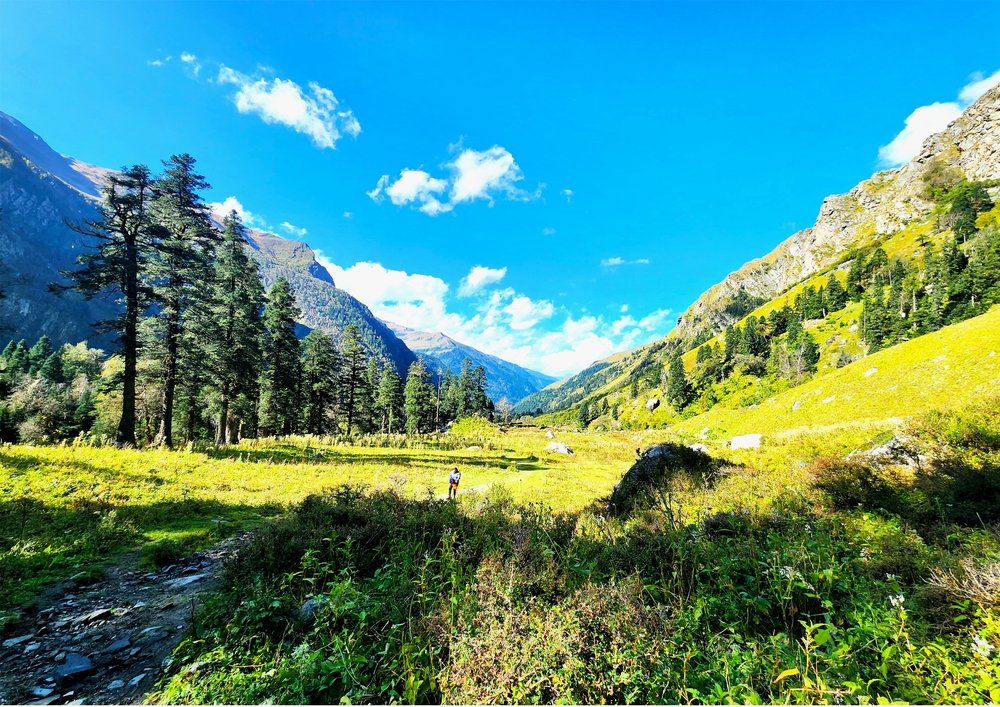
What Makes the Har Ki Dun Trek So Special?
The Har Ki Dun trek is one of the most culturally rich and scenically captivating treks in the entire Indian Himalaya. Tucked deep inside the Govind National Park in Uttarakhand’s Uttarkashi district, it leads trekkers into a living valley that has been continuously inhabited since Mahabharata times. According to local legend, the Pandavas passed through this valley on their final journey to heaven, and ancient wooden temples in nearby villages still carry the weight of that heritage.
Unlike many high-altitude snow treks, the Har Ki Dun trek rewards you at every step — not just at the summit. Lush meadows, gushing rivers, dense forests of oak and rhododendron, and centuries-old villages like Osla and Gangad make this a complete Himalayan experience. Whether you are planning a Har Ki Dun trek 7 days package or a shorter variant, this guide will give you everything you need to plan your journey confidently.
Har Ki Dun Trek at a Glance
| Trek Altitude | 11,675 ft (3,560 m) at the valley head |
| Trek Distance | Approx. 46 km round trip |
| Duration | 6 to 7 days (standard package) |
| Difficulty Level | Easy to Moderate |
| Starting Point | Taluka Village, Uttarkashi |
| Base Village | Sankri (drive head); Taluka (trek head) |
| National Park | Govind Pashu Vihar National Park |
| Best Season | March to June, September to December |
| Nearest Railhead | Dehradun (approx. 220 km) |
Best Time for the Har Ki Dun Trek: Season-by-Season Guide
The Har Ki Dun trek Uttarakhand is accessible in two main seasons, each offering a distinctly different experience:
Spring and Summer (March to June)
This is the most popular season. The trail bursts with rhododendron blooms in March and April. By May, the meadows are a brilliant green, temperatures are comfortable (8°C to 20°C in the valley), and river crossings are manageable. This is the ideal window for first-time trekkers.
Autumn (September to November)
Post-monsoon clarity is exceptional. The skies open up completely, delivering crisp mountain views. The forests turn gold and amber. October is widely considered the single best month for the Har Ki Dun trek due to the combination of clear skies, cool temperatures, and post-rain freshness.
Winter (December to February)
The trail is snow-covered and the valley is largely deserted. Only experienced winter trekkers should attempt this window. Temperatures can drop to -15°C at night, and several sections near the Har Ki Dun valley head become technically demanding under deep snow.
- Avoid July and August: The monsoon brings heavy rainfall, leeches, and trail damage. Most operators suspend fixed departure batches during this period.
Har Ki Dun Trek Itinerary: Day-by-Day Route Breakdown
The standard Har Ki Dun trek itinerary follows the Har Ki Dun trek Taluka route, beginning at Taluka village and proceeding through Seema and Osla villages before reaching the valley. Here is the classic 7-day structure:
Day-1: Dehradun to Sankri
- Altitude Sankri: 1950 m/ 6400 ft
- Drive Distance: 200 km | 9-10 hrs
Day-2: Sankri to Dharkot and trek to Osla Village
- Altitude:
- Osla: 2750 m/ 9000 ft
- Dharkot: 2500 m / 8400 ft
- Drive Distance (Sankri to Dharkot): 24 km | 2 hr
- Trek Distance: 8 km | 5-6 hrs
Day-3: Osla to Seematra
- Altitude Seematra: 3250 m/ 10800 ft
- Trek Distance: 7 km | 4-5 hrs
Day-4: Seematra to Har Ki Dun and Back to Seematra
- Altitude Har Ki Dun: 3500 m/ 11600 ft
- Trek Distance: 8 km (both sides) | 6-7 hrs
Day-5: Seematra to Pauni Gharat
- Altitude Pauni Gharat: 2500 m / 8300 ft
- Trek Distance: 8-9 km | 4-5 hrs
Day-6: Pauni Gharat to Dharkot and drive to Sankri
- Altitude Sankri: 1950 m / 6400 ft
- Trek Distance: 3-4 km | 2-3 hrs
- Drive Distance: 24 km | 2 hrs
Day-7: Sankri To Dehradun | Saying Goodbye To The Mountains
- Drive Distance: 200 km | 9-10 hrs
Note: The Har Ki Dun trek via Sankri is the most common approach. Sankri serves as the overnight acclimatization point before trekkers proceed to Taluka — the actual Har Ki Dun trek starting point for the foot trail.
Har Ki Dun Trek Difficulty Level: Is This the Right Trek for You?
The Har Ki Dun trek is rated Easy to Moderate. The maximum altitude is 11,675 ft — low enough to avoid serious altitude sickness for most healthy adults — and the daily distances are manageable at 7–13 km. There are no steep technical sections or glacier crossings on the standard route.
| Who Is This Trek Ideal For? First-time trekkers with basic fitness and some walking staminaFamilies with teenagers or fit adults above 50History and culture enthusiasts (ancient temples, Mahabharata legends)Nature photographers seeking diverse landscapes in a single routeSolo travelers or groups using a Har Ki Dun trek group booking slot |
Physical Preparation Checklist
- Start cardio training 4–6 weeks before departure (30–45 min daily jogging)
- Practice stair climbing with a loaded day-pack to simulate trail conditions
- No technical gear or prior Himalayan trekking experience needed
- Good hydration discipline is key — drink 3–4 litres of water daily on trail
Har Ki Dun Trek Cost: Package Pricing and What’s Included
The Har Ki Dun trek cost depends on the duration, operator quality, and seasonality. Below is a realistic pricing guide for the 2024–2025 season:
| Package Type | Approx. Price (INR per person) |
| 6-Day Standard Package | ₹8,500 – ₹12,000 |
| 7-Day Standard Package | ₹10,000 – ₹15,000 |
| 7-Day Premium Package | ₹15,000 – ₹22,000 |
| Group Booking (8+ persons) | 5–15% discount on base price |
| Fixed Departure (peak season) | ₹500–₹1,500 premium over off-peak |
A standard Har Ki Dun trek package typically includes: Dehradun pickup and drop (most operators offer Har Ki Dun trek pickup from Dehradun), accommodation in tents or homestays, all meals on the trail, certified mountain guide and support staff, Govind National Park entry permits, and basic first-aid support.
The Har Ki Dun trek price generally does not include personal travel insurance, personal trekking gear, tips for staff, or travel costs from your home city to Dehradun. Always request a detailed inclusion list when comparing operators offering Har Ki Dun trek online booking.
Har Ki Dun Trek Booking: Step-by-Step Guide
Whether you are doing a Har Ki Dun trek from Dehradun or planning a Har Ki Dun trek from Delhi, the booking process follows the same essential steps:
- Choose your dates: Identify your preferred month and check operator availability for Har Ki Dun trek fixed departure batches. Slots in October and May fill up 4–6 weeks in advance.
- Select a registered operator: Look for operators affiliated with the Indian Mountaineering Foundation (IMF) or listed with Uttarakhand Tourism. Read verified reviews on third-party platforms.
- Compare inclusion lists: Do not compare only headline Har Ki Dun trek cost — compare what each package covers, especially guide qualifications and safety equipment.
- Complete Har Ki Dun trek online booking: Most reputable operators accept a 25–50% deposit to secure your slot, with the balance due before departure.
- Get a medical certificate: Govind National Park regulations and responsible operators will require a basic fitness declaration. Consult your doctor if you have any pre-existing cardiac or respiratory conditions.
- Pack right: Your operator should provide a detailed packing list. Key items include insulated sleeping bag, trekking poles, waterproof jacket, and sturdy ankle-support boots.
Har Ki Dun Trek: Honest Pros and Cons
| ✅ Pros | ⚠️ Cons / Challenges |
| Rich cultural heritage — Mahabharata villages | No mobile network beyond Osla village |
| Diverse landscapes in a single route | Road from Dehradun to Sankri is long (7-8 hrs) |
| Lower altitude — no serious AMS risk | Monsoon season (Jul–Aug) is a hard no-go |
| Wildlife inside Govind National Park | Permit required — adds paperwork for self-trekkers |
| Suitable for beginners and families | Fewer dramatic summit views vs. high-altitude peaks |
| Comfortable 6–7 day pacing | Some river crossings can be challenging post-snowmelt |
Expert Tips for a Safe and Memorable Har Ki Dun Trek
On the Trail
- Start walking early — aim to reach camp by early afternoon to avoid afternoon fog and potential rain in shoulder seasons
- The stretch from Osla to Har Ki Dun valley has the most dramatic scenery; slow down and absorb it rather than rushing
- Osla’s Duryodhana Temple is a must-visit: this 800-year-old wooden temple dedicated to the Mahabharata villain is one of the most unusual religious sites in India — budget 30–45 minutes here
Gear and Safety
- Water purification tablets or a filter are essential — while water sources are generally clean, this is Himalayan wilderness
- Carry a printed permit copy: forest check-posts at the Govind National Park boundary require documentary proof of entry permits
- Carry cash — there are no ATMs beyond Sankri, and no online payments are accepted inside the forest zone
- A trekking first-aid kit should include blister care, antihistamines, altitude sickness medication (discuss with your doctor), and rehydration salts
Cultural Sensitivity
The villages of Osla and Gangad are inhabited communities with their own customs. Ask before photographing locals or temples. Remove footwear before entering any shrine. Supporting local tea stalls and homestays directly benefits the community and is strongly encouraged.
Conclusion: Why the Har Ki Dun Trek Deserves a Place on Your List
The Har Ki Dun trek stands apart from most Himalayan routes in one fundamental way: it does not ask you to simply endure a trail to reach a view. It asks you to inhabit a living, breathing landscape that has supported human civilization for centuries. From the ancient wooden temples of Osla to the wind-swept meadows at the valley head, every kilometre of this trek tells a story.
The moderate difficulty, manageable altitude, and rich cultural context make it genuinely accessible to a wide range of trekkers. Whether you’re a seasoned Himalayan trekker or planning your first mountain adventure, Har Ki Dun will exceed your expectations.
Plan your route, book a reliable operator, train consistently, and choose the right season. The Valley of Gods is waiting — and it rewards every trekker who arrives with genuine curiosity. Start your Har Ki Dun trek booking today and claim your place in this extraordinary corner of Uttarakhand.
Frequently Asked Questions (FAQ Schema)
Q: What is the best time to do the Har Ki Dun trek?
A: The best time for the Har Ki Dun trek is April to June for blooming landscapes and September to November for crystal-clear post-monsoon skies. October is widely considered the single finest month, offering stable weather, excellent visibility, and comfortable trail conditions. Avoid July and August due to heavy monsoon rains.
Q: How difficult is the Har Ki Dun trek?
A: The Har Ki Dun trek difficulty level is Easy to Moderate. The maximum altitude is 11,675 ft (3,560 m), which is manageable for most healthy adults with basic fitness. Daily distances range from 7–13 km, and there are no technical climbing sections. It is suitable for beginners and families with fit teenagers.
Q: What is the cost of the Har Ki Dun trek package?
A: The Har Ki Dun trek cost typically ranges from INR 8,500 to INR 22,000 per person, depending on the duration, operator quality, and season. A standard 7-day package (inclusive of transport from Dehradun, meals, camping, guide, and permits) generally costs INR 10,000 to INR 15,000. Group bookings of 8 or more persons usually attract a 5–15% discount.
Q: How do I reach the Har Ki Dun trek starting point?
A: The Har Ki Dun trek starting point is Taluka village in Uttarkashi district. Most trekkers travel from Dehradun (the nearest major city and railhead) by road to Sankri village — approximately 220 km or 7–8 hours. From Sankri, a 14 km jeep track leads to Taluka, where the foot trail begins. Operators offering a Har Ki Dun trek from Delhi typically arrange an overnight train or bus to Dehradun, followed by road transport to Sankri.
Q: Is the Har Ki Dun trek inside a national park? Do I need permits?
A: Yes, the Har Ki Dun trek passes through the Govind Pashu Vihar National Park and Wildlife Sanctuary. Trekkers are required to obtain entry permits, which are typically arranged by your trek operator as part of the package. Self-trekkers must obtain permits from the forest department office in Purola or Sankri before entering the park. There are check-posts on the trail where permits are verified. https://himalayatrekinn.com/